| Circuits | |
![]() |
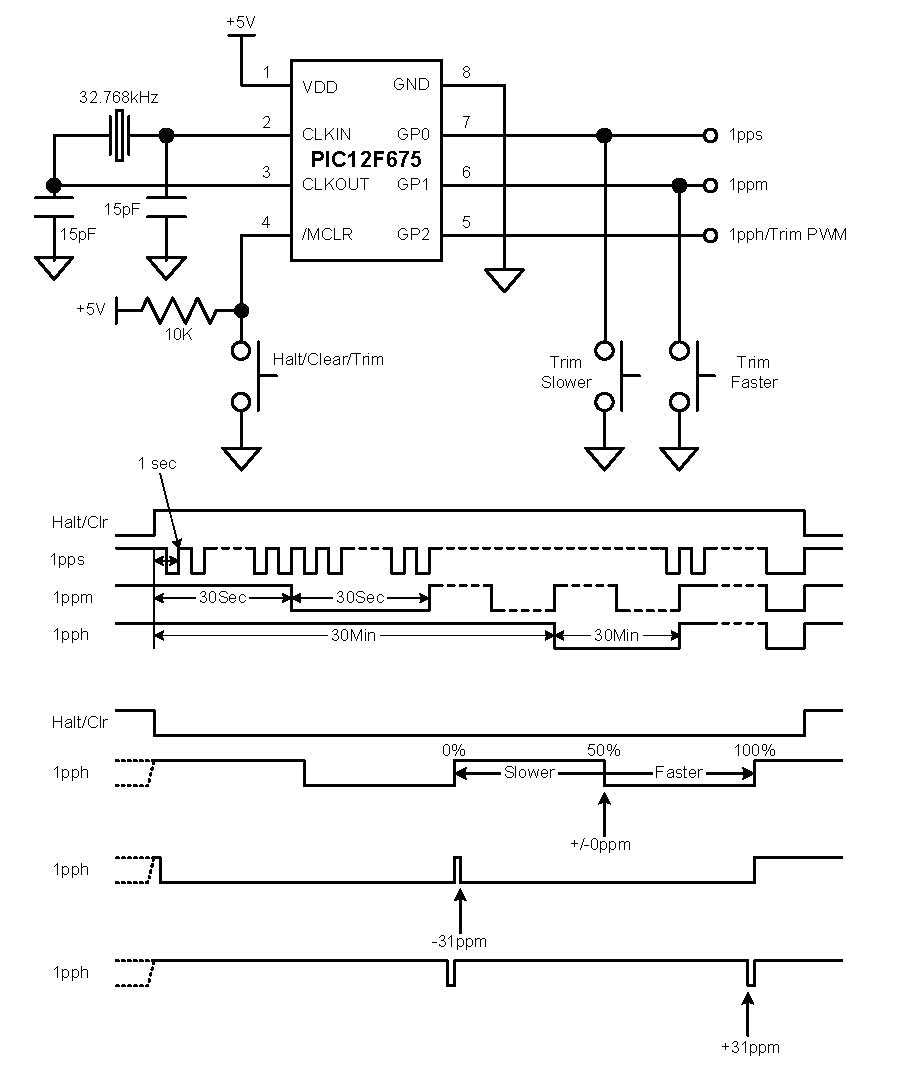
PIC Clock Divider II Source: r00 ROM: r00 Flow: rXX Similar the the PIC12F508 clock generator below, but now based on a PIC12F675. Instead of having to compute the number of clocks per correction and then writing that error adjustment into the code space, the three clock outputs double as error setting inputs while the /Reset line is held low. Pulsing the Seconds pin low "Slows down" the clock by 0.25ppm steps and pulsing the Minutes pin low "Speeds up" the clock by 0.25ppm steps. Pulsing both the Seconds and Minutes pins low together sets the trim to zero. This yields a maximum accuracy of +/-0.125ppm over a +/-31.75ppm range (+/- 127 steps). The Hours pin outputs a PWM proportional to the internal trim where 50% is zero, <50% is "Slow down" and >50% is "Speed up" The recommneded crystal is the MC-156 32.7680KA-A0 (DK SE2412CT) and two 15pF 10% NPO capacitors. |
![]() |
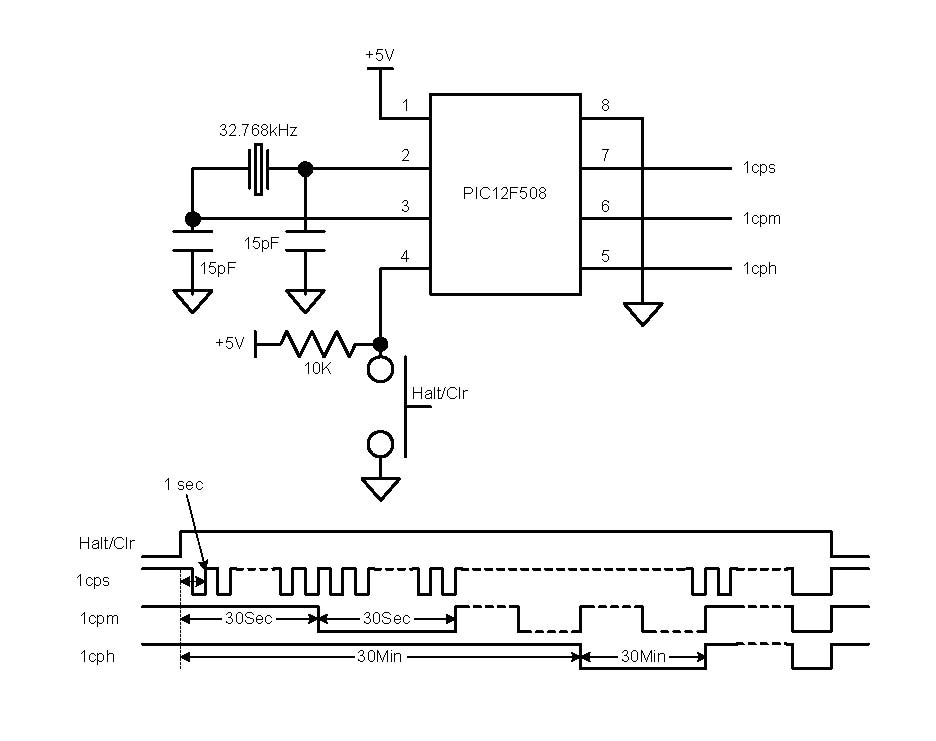
PIC Clock Divider Source: r02 / r01 / r00 Simple clock generator that puts out 1cps, 1cpm and 1cph square waves from a 32.768kHz clock crystal. The next level of complexity would be to add a frequency trim to tune out the crystal error which on my first try was about +6 seconds per 4 days. This could be from a better quality crystal, a TCXO as the clock source (No change to the code) or perhaps even a pulse skip programmed into the firmware; drop a second pulse after a seconds' worth of error which would look like a leap year adjustment. |
![]() |
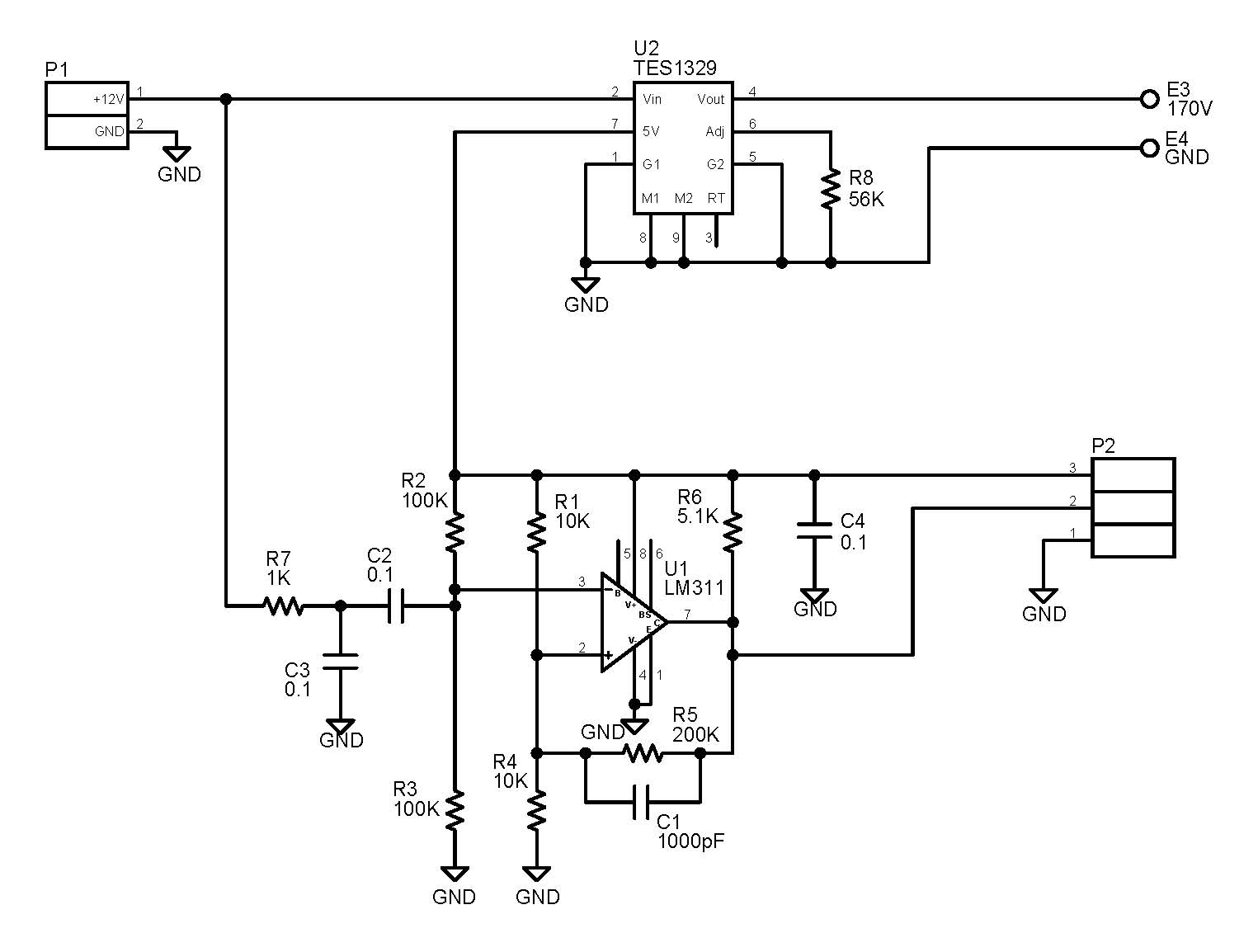
Line Ripple Clock This circuit converts the ripple from a wall wart supply to a clean Line x 2 digitial clock. Doing it this way eliminates the need to put AC into the unit which then has to be rectified and filtered just to have access to the line frequency sine wave. |
![]() |
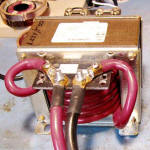
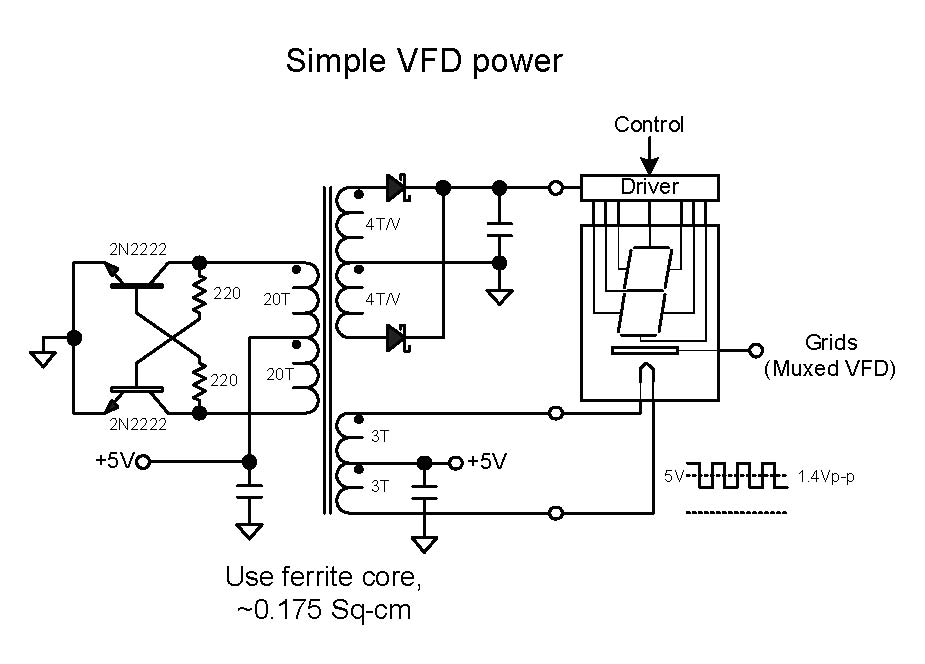
Simple VFD Power This is a simple saturating converter that supplies both the high voltage anode power as well as an AC filament driver centered around 5VDC to allow segments at zero volts to be completely off. This same circuit was used to power a 32 character 14 secment VFD I was using back in the '80s. The primary voltage, primary turns, core cross section area and core saturation flux density set the operating frequency: The example should run about 10KHz. See Calculators program for transformer design help. |
![]() |
Poor man's datalogger Using the "Questionable mask register set" command, I am sneaking 10 bits of command data into the aluminum box daisy chained into the meters RS232 port to control a 1-of-8 break-before-make DPDT relay multiplexor. Controlled by a VB GUI, I am reading input and output power and switcher frequency to measure efficiency at various operating points. The power supply in the foreground is a prototype of the nixie power supply in the TES store. (My fluke hydra is on loan, but this gives better resolution anyhow!) |
![]() |
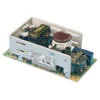
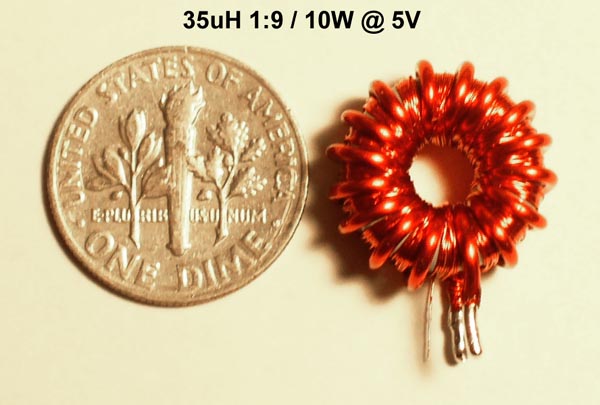
High Efficiency boost converter with target output of 170V at 40mA, sufficient to drive 8 large tubes. At left is the transformer. I went with an LP ferrite core set instead of the torroid for easier winding. The final design was also push-pull vs the original tapped inductor to allow higher throughput power: Nixie PS |
![]() |
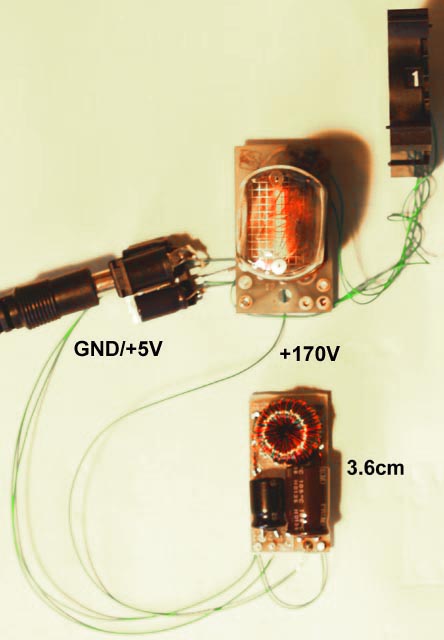
Simple Nixie tube boost converter. Draws 72.8mA at 5VDC to produce 170VDC no load. Turning on a single nixie segment at 710uA load increases the input current to 85mA: Nixie PS |
|
AC Current
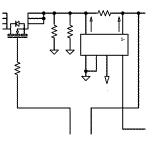
controlled relay Self powered solid state relay switches on when the AC current through the sensing loop exceeds the preset limit. The trip point is adjustable in the circuit as shown from about 40 to 150 watts of load current and consumes only about 50mW. Sensitivity can be adjusted by changing the number of turns on the sense winding (Here set to 5). Safety isolation is intrinsic to the design. Any SSR with an LED control input will work with this circuit, the one chosen here has a 60V-AC/DC contact function rated for 400mA maximum. |
|
|
PIC controlled spot welder This circuit pulses half cycles of AC current into the primary of a transformer which has had its secondary removed and replaced with a few, really thick turns. The PIC controls an opto coupled triac which then triggers a power triac connected between the primary AC power and the transformer primary. With the keypad, custom heat cycles can be programmed and then with the press of the "fire" button (Or foot switch) applied to the work piece: ((h x 8.33ms) + (r x 8.33ms)) x p. The time unit is 8.33ms because all timing is based on the line frequency x 2. h=heating, r=resting, p=pulses. I have melted tungsten rods in half with no problem with this unit. Releasing the "fire" button in the middle of a heat cycle terminates the cycle. The firmware was done in PIC ASM, and only far enough to do the job it was built for (Welding tabs onto batteries). The plan was to be able to enter in and save complex profiles etc. I suggest the APT1211 optocoupler and Q2008L4 alternistor to drive the transformer primary and provide PIC to mains isolation. Gerber Data / Firmware |
|
![]() |
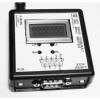
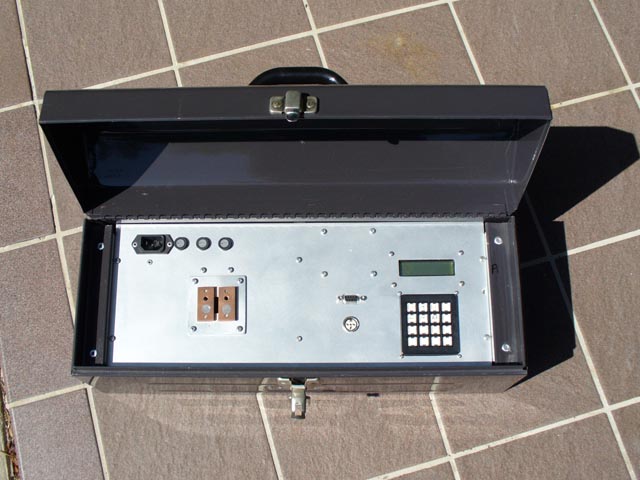
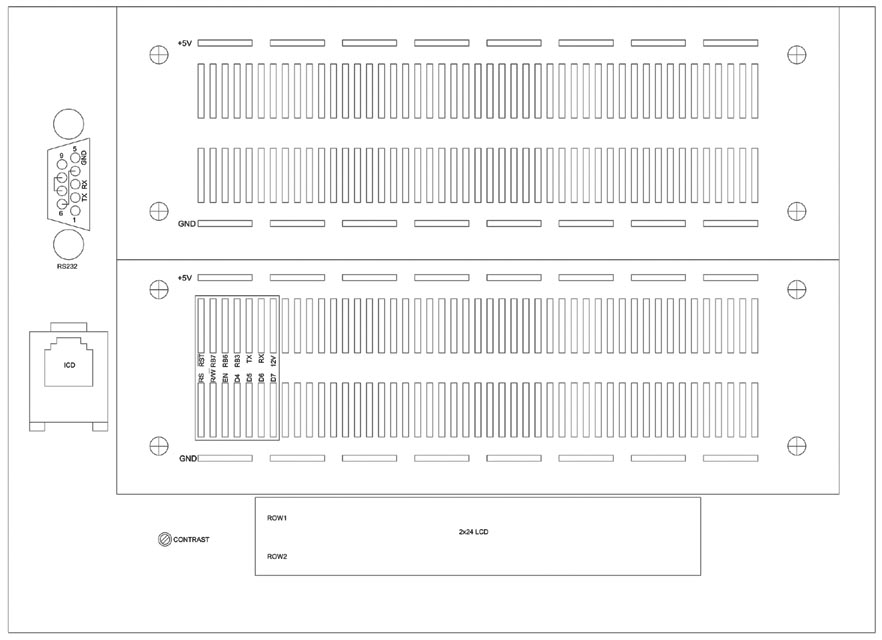
PIC prototyping box I built several of these for friends and family as a way to jump start them into PIC programming. It had a Power supply, prototype area, LCD and RS232 driver pre wired inside in addition to an ICD interface. |
![]() |
PIC Output Expansion (74595):
Serial In/Parallel Out |
Any questions or comments?
This page last updated on
October 22, 2008